Karate Coordination Exercises for Children

A child who can throw a punch is learning a movement. A child who can plant their feet, control their breathing, turn with balance, and stop precisely on command is building a skill that reaches far beyond the dojo. The best karate coordination exercises children practice are not about moving fast for the sake of it. They teach young students how to direct attention, understand their bodies, and stay composed when a task becomes challenging.
For families, that difference matters. Coordination supports safer play, stronger sports skills, better posture, and greater confidence in everyday movement. In traditional Kosho Ryu Kenpo training, it also becomes the foundation for technical precision, practical self-defense, and the focused habits of a warrior.
Why coordination matters in children’s karate
Coordination is the ability to make different parts of the body work together with control. For a young karate student, that might mean stepping forward as they punch, maintaining a stable stance while blocking, or changing direction without losing balance. These movements can look simple to an adult, but they ask a child to process timing, space, balance, and instruction all at once.
That challenge is valuable when it is taught patiently. Children ages 5 to 12 are still developing body awareness. Some naturally move with speed but need help slowing down. Others are careful and focused but need encouragement to move with more confidence. A skilled instructor meets both students where they are, then gives them a clear next step.
Coordination training can also strengthen concentration. A child who listens for a command, remembers a sequence, and adjusts their stance is practicing attention under mild pressure. Over time, that practice can carry into schoolwork, conversations at home, and situations where they need to pause before reacting.
Karate coordination exercises for children that build real skills
The most effective exercises are purposeful, age-appropriate, and connected to martial arts technique. They do not need to be complicated. In fact, younger students often make the greatest progress when one movement is practiced carefully before several movements are put together.
Stance-and-step practice
A strong stance gives every karate technique a base. In stance-and-step practice, children begin in a balanced position, then take one controlled step forward, backward, or to the side while keeping their posture upright. The goal is not to cover ground quickly. It is to move without crossing the feet, leaning excessively, or losing control of the hands.
This exercise develops balance and spatial awareness. It also teaches a lesson children can understand: power starts from the ground. When students learn to place their feet with care, their punches, blocks, and defensive movements become more stable.
At home, a parent can reinforce this skill with a simple “quiet feet” challenge. Ask your child to take five slow steps along an imaginary line while keeping their hands in guard position. Keep it light and encouraging. If they wobble, that is not failure. It is information they can use on the next attempt.
Hand-and-foot combinations
Many beginners can focus on either their hands or their feet, but combining both takes practice. A basic example is stepping forward with a front punch, then returning to a ready position. The hands must move at the correct time, the feet must land with control, and the child must remember which side comes next.
This type of drill helps children build bilateral coordination - the ability to use the right and left sides of the body intentionally. It can be especially helpful for students who mix up right and left or rush through a sequence before they are ready.
The trade-off is that combinations can overwhelm a child if too many details are introduced at once. Instructors should first establish the stance, then add the step, then add the punch. Technical mastery grows through layers. A student does not need to get everything perfect immediately to make meaningful progress.
Mirror drills with a partner
Mirror drills are a powerful way to build coordination while teaching respect and awareness. Two students face one another. One leads with slow, simple movements such as raising a guard, stepping to the side, or performing a basic block, while the other mirrors the action. Then they switch roles.
Because children must watch closely and respond without crashing into their partner, mirror drills teach timing, self-control, and personal space. They also reinforce the community side of martial arts. A child learns that training is not about showing off or overpowering someone else. It is about helping one another improve safely.
For shy students, partner work may take time. A supportive dojo does not force a child to perform before they are ready. Instead, instructors can begin with low-pressure pairings and clear expectations, allowing confidence to grow through repeated positive experiences.
Target work with controlled strikes
Striking a focus mitt or pad gives children immediate feedback. They can feel whether their hand landed squarely, whether their stance was balanced, and whether they stopped after the technique. When target work is structured correctly, it is not wild swinging. It is a lesson in distance, accuracy, and restraint.
A simple drill might involve stepping into range, delivering one focused punch, returning to guard, and waiting for the next instruction. This sequence builds hand-eye coordination and reinforces the habit of listening before acting.
Speed can come later. Early on, controlled form is more valuable than hard contact. A child who learns to stop a technique precisely is developing the self-control that makes martial arts training safe and meaningful.
Balance challenges and kicking control
Kicks require children to balance on one leg while moving the other with intention. Before asking a student to kick high or fast, good instruction begins with posture, chamber position, and a controlled return of the foot to the floor.
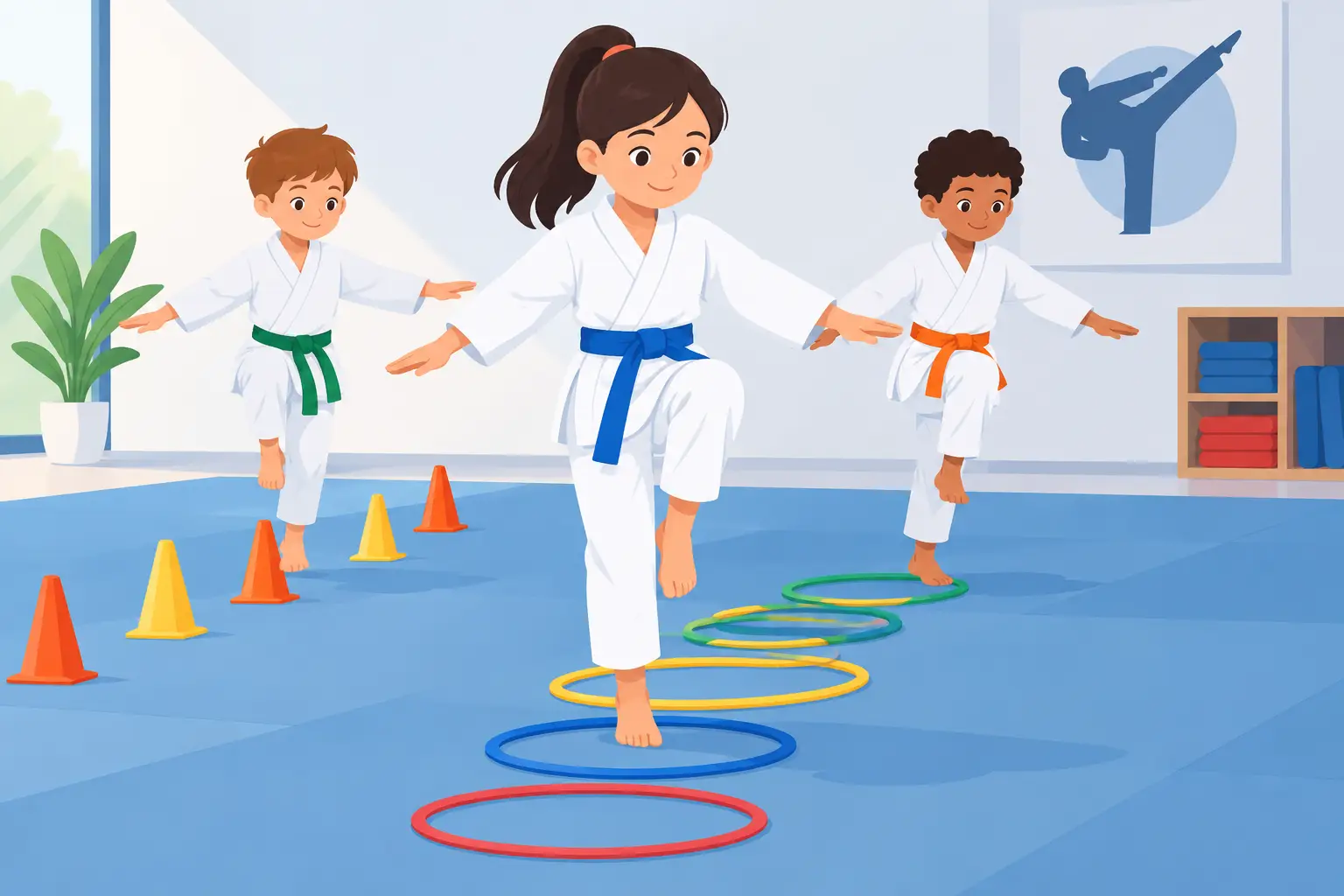
Balance challenges may include holding a knee-up position for a few seconds, performing a slow front kick, or stepping over a low obstacle without touching it. These exercises strengthen the legs and core while helping children recognize when their bodies are tipping or twisting.
Not every child will progress at the same rate. Growth spurts, different athletic backgrounds, and simple fatigue can affect balance from week to week. The goal is steady improvement, not comparison. This is where the perseverance principle of nana korobi ya oki - fall down seven times, get up eight - becomes real for young students.
How coordination supports confidence outside the dojo
Children often recognize physical progress before they can explain it. They notice that they no longer stumble during a combination, that they can remember a longer sequence, or that they can stand in front of the group with a stronger posture. Those small victories create evidence: “I can learn difficult things.”
That evidence supports confidence without encouraging arrogance. Karate asks students to be humble enough to accept correction, disciplined enough to repeat a skill, and resilient enough to try again after a mistake. These are habits that serve children in a classroom, on a team, and at home.
Coordination work also gives energetic children a constructive outlet. Rather than simply being told to calm down, they learn how to channel energy into a stance, a sequence, or a focused drill. Children who need extra encouragement to participate can benefit as well, because the structure of class makes expectations clear and progress visible.
What parents should look for in a karate class
A quality children’s program balances high standards with patience. Look for instruction that explains why a movement matters, not just what to copy. Young students should receive corrections in a way that is clear, respectful, and achievable.
The class environment matters just as much as the exercise. Children need room to challenge themselves, but they also need to feel safe making mistakes. At Bay Area’s Best Kosho Ryu Kenpo Karate, traditional training is paired with individualized attention so students can develop technical skill at a pace that supports lasting confidence.
Parents can help by praising effort, listening, and self-control alongside visible achievements. Ask your child what they practiced, what felt difficult, and what they want to improve next time. Those questions show them that karate is not only about earning a belt. It is about becoming more focused, capable, and resilient with every class.
A well-timed block or balanced kick may seem like a small accomplishment, but for a child, it can be the moment they realize that patient practice changes what they are capable of doing.
Comments