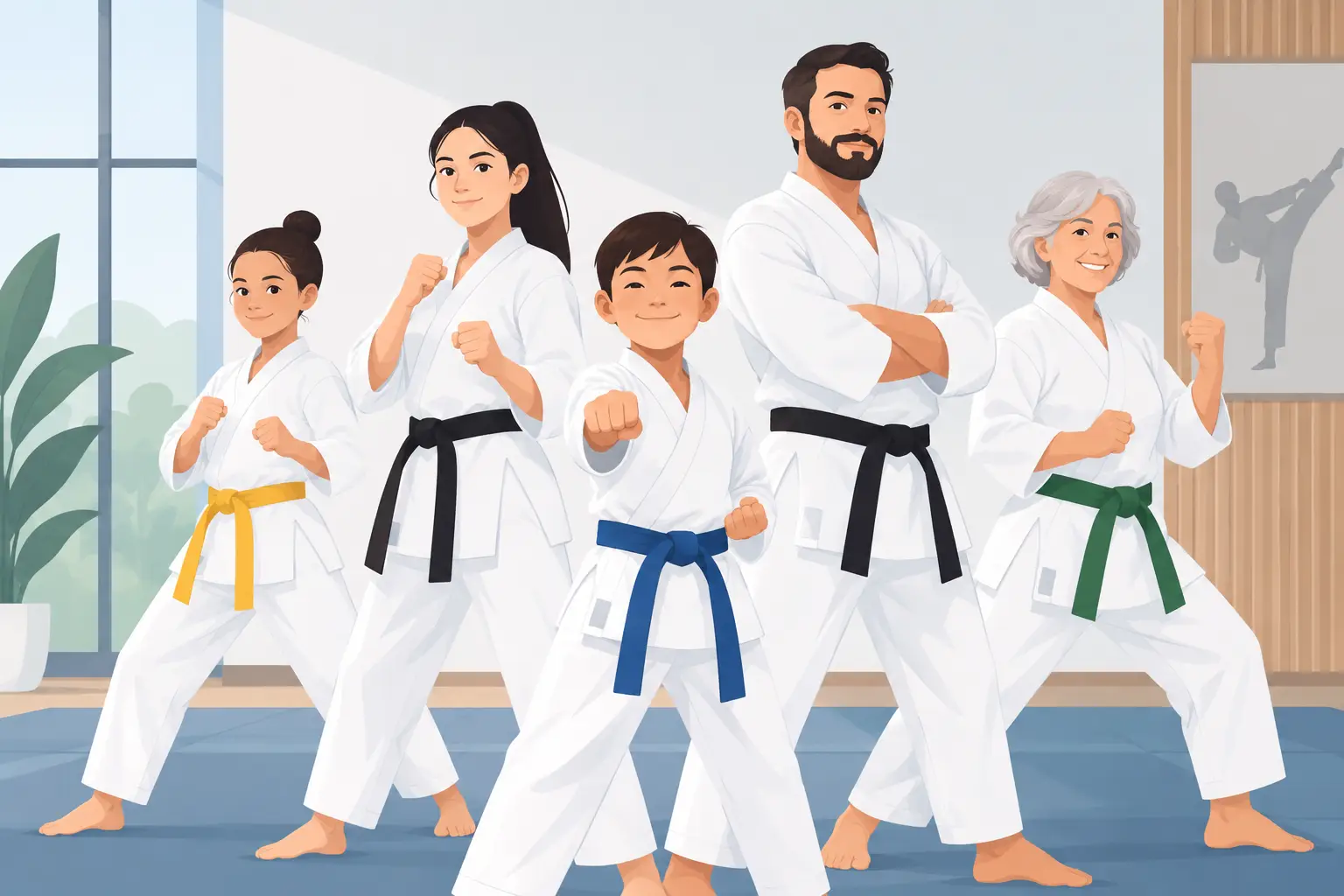
How Karate Builds Confidence at Every Age

A child stands at the edge of the mat, unsure whether they can remember the first stance. An adult walks in after a difficult week, carrying the quiet doubt that comes with feeling out of shape or stuck. Neither needs a speech about being fearless. They need a place to practice, make mistakes safely, and see proof that they can improve. That is how karate builds confidence: not through empty praise, but through earned progress.
In traditional Kosho Ryu Kenpo, confidence is not loudness or aggression. It is the ability to stay composed, make a clear decision, and keep moving forward when a challenge feels uncomfortable. Students build it one class, one technique, and one recovery at a time.
How Karate Builds Confidence Through Practice
Confidence grows when a student learns to trust their own effort. Karate gives that effort a structure. There is a stance to refine, a block to coordinate, a form to remember, and a goal to work toward. At first, even simple movements may feel unfamiliar. With patient repetition, the body begins to understand what the mind has been learning.
That shift matters. A student who once said, “I can’t do this,” eventually performs the same movement with control. They have physical evidence that practice changes ability. This is more durable than confidence based on a compliment, a good grade, or an easy win. It becomes an inner reference point: I did not know how to do this before, and now I do.
Technical precision is central to that process. Students are encouraged to pay attention to posture, balance, timing, focus, and respect for their training partners. Clear standards give them a path forward. Instead of wondering whether they are simply “good” or “bad” at karate, they learn what to improve next.
Small wins create real belief
A new belt, a completed form, or a successful board-breaking experience can be exciting milestones. Yet the quieter victories often build the deepest confidence. A child who raises their hand when called on, a teen who returns after a frustrating class, or an adult who keeps a steady stance under pressure is developing warrior habits.
These wins do not happen on the same timeline for every student. Some children become comfortable moving in front of others quickly. Others need more time and encouragement. A supportive dojo honors individual progress while still asking each student to give their honest effort.
Confidence Is Different From Being the Toughest
Parents sometimes worry that martial arts will make their child aggressive. Quality karate training teaches the opposite. A confident student does not need to prove their strength by pushing others around. They learn self-control, awareness, and the responsibility that comes with knowing how to defend themselves.
Practical self-defense can reduce anxiety because students know they have options. They learn to pay attention to their surroundings, use their voice, maintain distance, and seek help when needed. Physical techniques are taught within a larger framework of discipline and sound judgment. The goal is not to look for conflict. The goal is to carry yourself with calm confidence and avoid it whenever possible.
For children, this often changes how they respond to everyday social pressure. They may stand a little taller, speak more clearly, or recover more easily from a disagreement. For teens, it can mean better boundaries and less need to follow the crowd. For adults, it may mean walking into a meeting, a difficult conversation, or a new physical challenge with greater presence.
The Role of Failure in Building Resilience
No one begins karate with perfect coordination. Students forget steps, lose balance, misunderstand directions, and sometimes feel discouraged. Those moments are not evidence that they do not belong. They are part of training.
The Japanese perseverance philosophy of nana korobi ya oki means fall down seven times, get up eight. In a dojo, students experience this idea in a practical way. They miss a technique, receive correction, try again, and improve. Over time, they stop treating mistakes as permanent labels.
That lesson carries far beyond the mat. School assignments become less intimidating when a child has learned to break a difficult form into smaller parts. A teenager may handle a disappointing tryout or test score with more perspective. An adult can approach a career change or fitness setback without deciding it is too late to begin again.
Resilience does not mean pretending disappointment does not hurt. It means learning that disappointment can be followed by action. Karate creates regular, manageable opportunities to practice that response.
Focus and Self-Control Support Confident Decisions
Confidence is easier to sustain when a student can direct their attention. Karate classes ask students to listen closely, watch demonstrations, follow sequences, and control their movement. These demands strengthen concentration in a way that feels active and purposeful.
For younger students, learning to wait for instruction and use respectful language can improve how they participate at home and school. They discover that self-control is not a punishment. It is a skill that helps them succeed. When they can pause before reacting, they are more likely to make choices they feel proud of afterward.
Teenagers and adults benefit from this discipline as well. A focused training session offers a break from constant notifications and scattered attention. The work is direct: breathe, move with intention, correct the technique, and stay present. That clarity can build the kind of confidence that does not depend on external approval.
Why Community Matters in Confidence Building
Confidence develops faster in an environment where students feel safe enough to be beginners. A family-oriented dojo provides encouragement without lowering standards. Students can work hard, ask questions, and receive correction without embarrassment.
At Bay Area’s Best Kosho Ryu Kenpo Karate, students train alongside people at different stages of their journey. Younger children see what steady practice can lead to. Teens can become positive examples for newer students. Adults rediscover that it is possible to begin something demanding at any age. This shared effort creates accountability and belonging.
The instructor’s role is equally important. Patience and individualized attention help students understand that they are seen as people, not just as another face in class. Some students need a movement explained in a different way. Some need time to build comfort. Others need a clear challenge to rise to. Effective instruction balances support with the expectation that every student can grow.
What Parents Can Look for in a Karate Program
Not every martial arts program builds confidence in the same way. Fitness, competition, and fast promotions can each have a place, depending on a family’s goals. But parents seeking lasting character development should look beyond the uniform and belt display.
A strong program teaches physical skills with clear standards, emphasizes respect and safety, and gives children meaningful chances to work through difficulty. It should welcome beginners without making training feel casual or directionless. The best environment is serious about mastery while remaining warm enough for students to take healthy risks.
Consistency also matters more than intensity. One exciting class may spark interest, but regular attendance builds the habits that change a student’s self-image. Progress can be gradual, especially for a shy child or a busy adult. That is not a weakness in the process. It is how confidence becomes part of everyday life rather than something that appears only during a performance.
The next time a student ties their belt, takes a ready stance, and tries again after a mistake, they are practicing more than karate. They are learning that confidence is built through action - and that lesson will be there when life asks them to stand tall.
Comments