Kenpo Versus Taekwondo: Which Fits Your Family?

A child who needs help speaking up in class may not need the same training experience as a teenager who wants athletic challenge or an adult seeking practical self-defense. That is why the question of kenpo versus taekwondo is more useful than asking which art is simply “better.” Both can build fitness, confidence, and discipline. The right choice comes down to how each style moves, what it emphasizes, and whether its school gives your family the support to keep showing up.
Kenpo Versus Taekwondo: The Core Difference
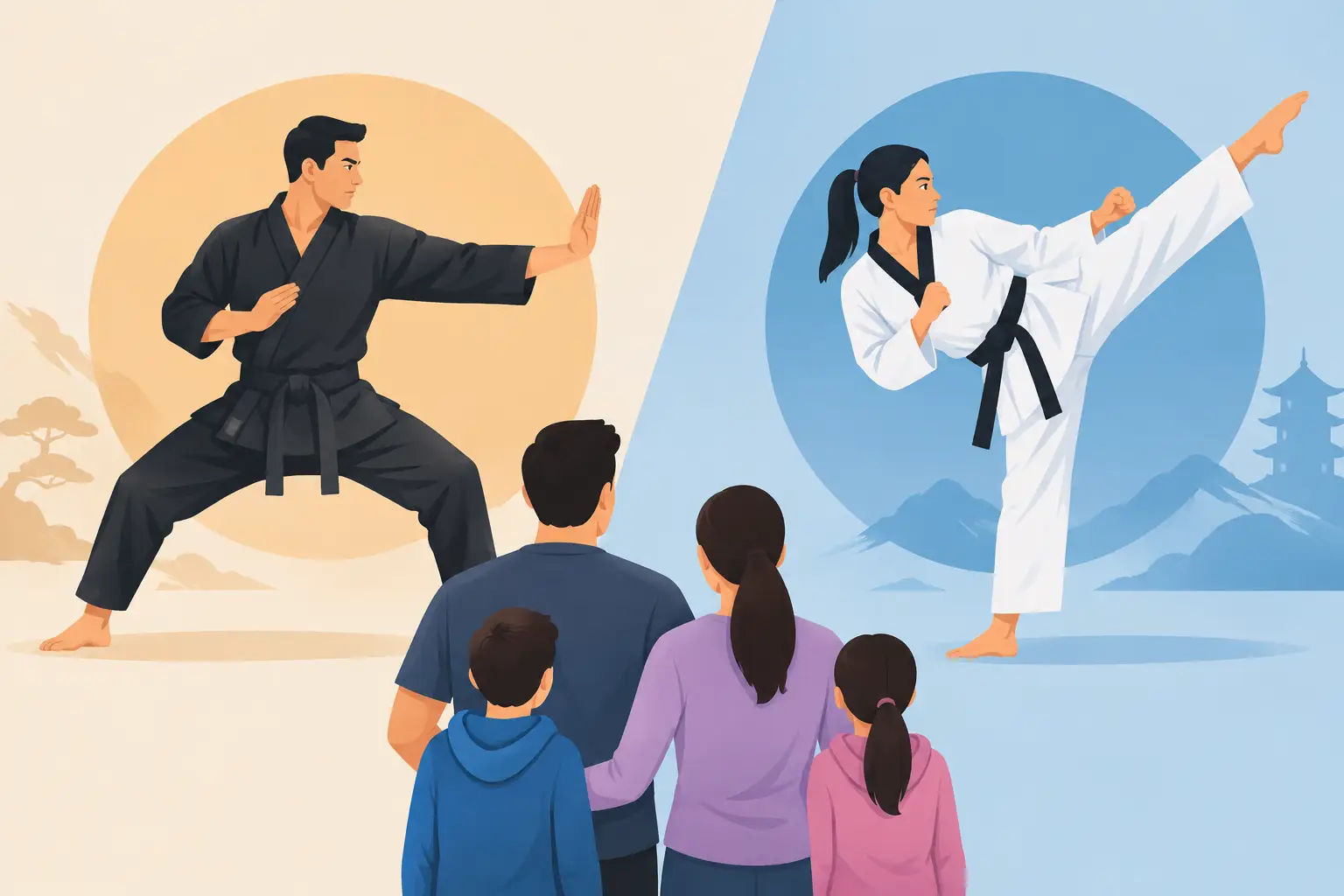
Kenpo and Taekwondo are both striking arts, but they approach movement from different traditions and priorities. Traditional Kenpo, including Kosho Ryu Kenpo, teaches students to respond with efficient body mechanics, coordinated strikes, blocks, footwork, and practical self-defense principles. Training asks students to pay close attention to timing, distance, posture, and control.
Taekwondo, which originated in Korea, is widely recognized for its dynamic kicking techniques. Students often develop speed, flexibility, balance, and powerful kicks, including high and spinning kicks. Many Taekwondo schools also include forms, self-defense, sparring, and competition opportunities.
Neither approach is automatically a better fit for every student. A child who loves explosive athletic movement may be drawn to Taekwondo's kicking repertoire. A student who benefits from detailed technical instruction and close-range self-defense skills may feel more at home in Kenpo. The quality and culture of the individual dojo matter just as much as the name of the style on the sign.
How the Movement Feels in Each Art
Kenpo combines hands, feet, and purposeful movement
Kenpo students learn that effective self-defense is not about throwing the biggest punch or memorizing a flashy sequence. It is about moving with awareness and using the right response at the right moment. Training commonly includes punches, palm strikes, blocks, kicks, stance work, body positioning, and combinations that flow from one motion to the next.
For younger students, this detailed work can become a powerful lesson in concentration. They learn to listen carefully, follow directions in order, and make corrections without giving up. A technique may take patience to understand, but that patience develops habits of a warrior: focus, humility, and the willingness to improve one repetition at a time.
Kosho Ryu Kenpo also places value on controlled power. Students do not need to be naturally big, fast, or aggressive to make progress. Precise movement, balance, and awareness can help a smaller student feel capable while reinforcing the responsibility that comes with martial arts skill.
Taekwondo emphasizes kicking range and athleticism
Taekwondo develops strong lower-body coordination. Students spend considerable time learning front kicks, roundhouse kicks, side kicks, and, depending on the program, advanced jumping or spinning techniques. That training can be especially appealing to children and teens who enjoy active, high-energy classes.
The athletic benefits are real. Regular kicking practice can improve flexibility, balance, coordination, and cardiovascular fitness. Students also gain confidence as they learn to control movements that initially seem difficult.
There are trade-offs. High kicks require mobility, balance, and careful instruction, and they may take longer for some beginners to perform with confidence. A good Taekwondo instructor will meet students where they are rather than expecting every child to kick at the same height or progress at the same pace.
Self-Defense: Practicality Depends on the School
Parents often compare Kenpo versus Taekwondo because they want their child to have useful self-defense skills. That concern is understandable, but the answer is more nuanced than one style winning on paper.
Kenpo's emphasis on distance, timing, hand techniques, and coordinated responses can translate naturally to practical self-defense lessons. Students learn to stay aware, create space, use their voice, and respond with control rather than panic. In a traditional setting, self-defense is taught alongside respect and judgment. The goal is never to encourage confrontation. It is to help students become more alert, composed, and capable of protecting themselves when needed.
Taekwondo can also provide meaningful self-defense training, particularly when a school teaches more than sport sparring. Strong kicking range can be useful, and the confidence built through disciplined practice matters in any situation. Still, programs vary widely. Some schools focus heavily on tournament rules and point sparring, while others give more time to practical applications.
When visiting any martial arts school, ask how it teaches conflict avoidance, situational awareness, and self-control. Those lessons may matter more in everyday life than whether a student throws more punches or more kicks.
Forms, Sparring, and the Road to Mastery
Both arts use structured practice to build skill over time. Students may learn forms, sometimes called kata or poomsae, which are arranged patterns of techniques. Forms teach memory, coordination, balance, breathing, and discipline. They also give students a visible way to measure progress as they advance.
Sparring is another area where programs differ. Taekwondo sparring is often associated with controlled kicking and competitive scoring. For students who enjoy competition, this can be exciting and motivating. It teaches timing, courage, and the ability to stay calm under pressure.
Kenpo sparring and partner drills often place strong attention on distance, defensive movement, combinations, and controlled reactions. At Bay Area's Best Kosho Ryu Kenpo Karate, students are guided toward technical mastery in a supportive environment, so they can challenge themselves without feeling lost in the crowd.
For families, the key question is not whether sparring is included. It is whether it is taught safely, respectfully, and at an appropriate level for the student. A beginning child should not be pushed into contact before they have the control and confidence to participate responsibly.
Which Style Is Best for Children?
The best martial art for a child is one they can attend consistently, enjoy sincerely, and learn from over the long term. A child who feels welcomed is more likely to practice. A child who receives clear standards and patient coaching is more likely to develop resilience when training becomes difficult.
Kenpo may be an excellent choice for children who need structure, focus, practical movement, and individualized attention. Its technical nature gives students many opportunities to practice listening, self-control, and perseverance. These are skills that carry into homework, friendships, family responsibilities, and classroom challenges.
Taekwondo may be a strong fit for children energized by kicking, athletic drills, and the possibility of sport competition. It can help a reserved child become more expressive and help an active child channel energy into disciplined movement.
A child does not need to choose based on personality alone, however. Quiet children can thrive in energetic Taekwondo classes, and highly active children can learn remarkable focus through Kenpo. The instructor's ability to recognize each student's strengths, needs, and learning style is what turns martial arts from an activity into a lasting source of growth.
What Adults Should Consider
Adults often come to martial arts with practical goals: improving fitness, gaining confidence, reducing stress, or learning self-defense. Kenpo can appeal to adults who want close attention to mechanics and applicable movement without relying on flexibility alone. It rewards patience and consistent practice, whether someone is returning to exercise or beginning for the first time.
Taekwondo can be a rewarding option for adults who enjoy kicking, mobility training, and a fast-paced workout. It may challenge flexibility and endurance in ways that feel refreshing for one person and demanding for another. Previous injuries, current fitness, and personal goals should shape the decision.
No adult needs to arrive in perfect condition to begin. The right school builds students gradually, respects limitations, and celebrates steady progress. Falling behind is not failure. The traditional philosophy of nana korobi ya oki reminds us: fall down seven times, get up eight.
Choose a Dojo, Not Just a Style
A style name tells you something about the curriculum, but it cannot tell you whether your child will be treated with patience, whether beginners receive real instruction, or whether the community feels right for your family. Visit a class. Notice whether students show respect without fear, whether instructors correct with clarity, and whether each student has room to grow.
The strongest martial arts experience is one that builds more than kicks, punches, or belts. Look for a place where your child can develop unstoppable confidence, laser-sharp focus, and the resilience to get back up after a difficult day. Those lessons will matter long after class ends.
Comments