Karate Versus Team Sports: What Fits Your Child?

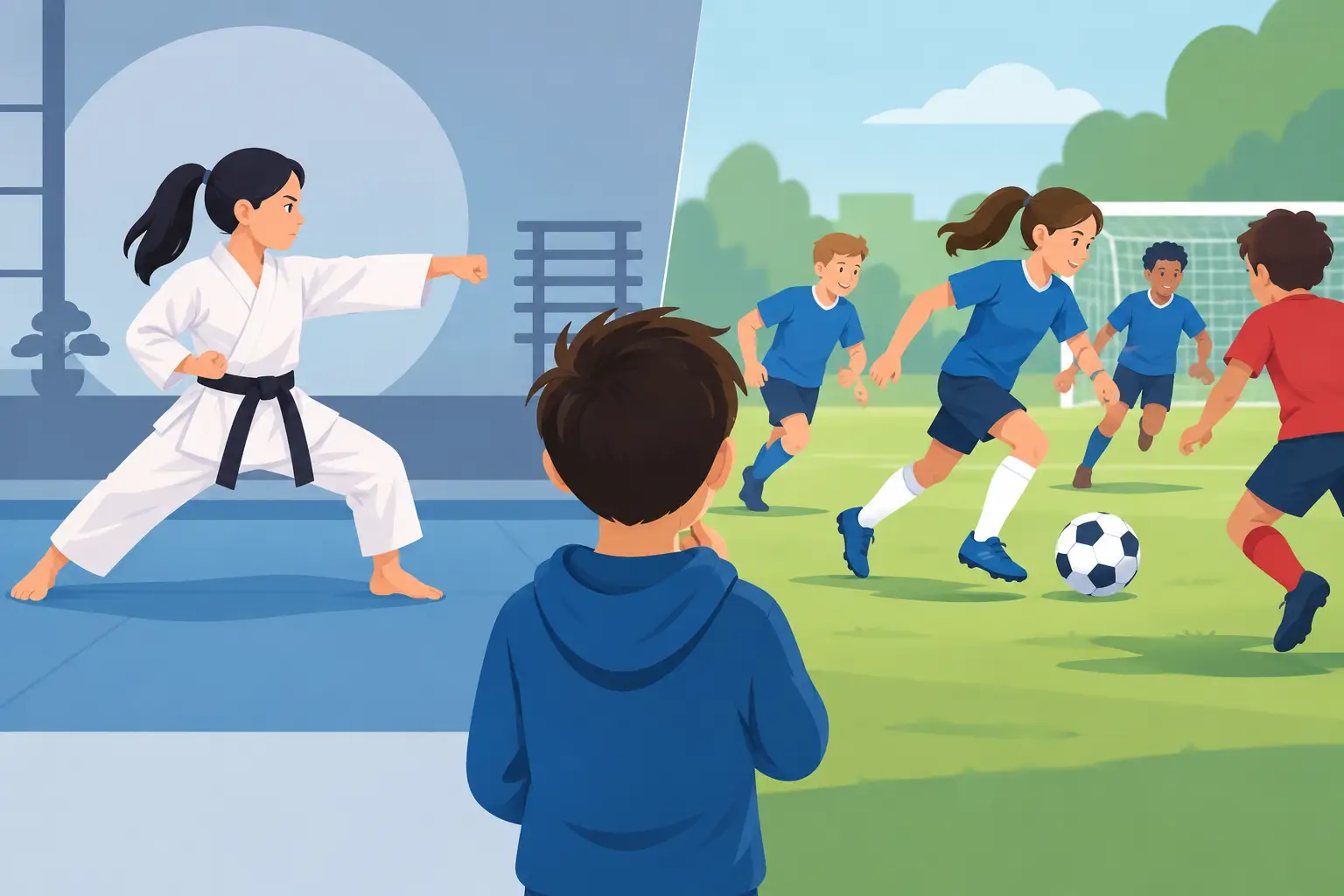
A child standing at the edge of a soccer field may need something very different from a child who lights up when practicing a precise new stance. Parents comparing karate versus team sports are not choosing between a “good” and “bad” activity. They are deciding which environment can best help their child become more confident, focused, active, and resilient.
Both paths offer real benefits. Team sports can build friendship, communication, and a sense of shared purpose. Traditional karate offers an individual path of technical mastery, self-control, practical self-defense, and steady personal growth. The right answer often comes down to your child’s temperament, needs, and goals.
Karate Versus Team Sports: The Core Difference
The biggest difference is where a child’s progress begins. In team sports, success is tied to the group. A player learns to pass, communicate, accept coaching, and contribute to a larger result. That experience can be powerful, especially for children who enjoy social energy and thrive when working toward a common goal.
Karate starts with personal responsibility. Students learn that their stance, attention, effort, and attitude belong to them. They cannot rely on a faster teammate to score or a stronger player to cover a mistake. When they earn a new belt, improve a technique, or keep trying after a difficult class, the growth is unmistakably their own.
That does not mean karate is solitary. A healthy dojo is a community. Students train beside peers, learn respect for partners, encourage one another, and follow the example of more experienced students. The difference is that each child is measured against their own developing skill, not only against the scoreboard or a teammate’s performance.
What Team Sports Can Teach Children
Team sports are an excellent choice for many young people. They create regular opportunities to cooperate, handle changing situations, and learn how individual decisions affect others. A child who loves soccer, basketball, baseball, or volleyball may find deep motivation in being part of a team.
Games also teach children to manage wins and losses in public. They learn that a missed shot or difficult game does not define them, and that celebrating a teammate’s success matters. For outgoing children, the social rhythm of practices, games, and shared team traditions can create lasting friendships.
There are trade-offs, though. Playing time, positions, and team outcomes are not always within a child’s control. A beginner may spend much of a season waiting for a chance to participate. Some children become discouraged when the pace moves too quickly, when teams are highly competitive, or when their effort is hard to see amid the larger group.
For families, team schedules can also become demanding. Weekend games, travel, seasonal commitments, and changing practice times may fit well for some households but create pressure for others.
Why Karate Builds a Different Kind of Confidence
Karate confidence is not based on being the best athlete in the room. It grows from preparation. A student practices a movement, receives correction, practices again, and eventually feels the difference between guessing and knowing. That process gives children a durable kind of self-belief: I can work through something difficult.
At Bay Area’s Best Kosho Ryu Kenpo Karate, traditional instruction makes that process clear. Students learn focused movement, technical precision, respectful conduct, and practical self-defense in an environment with standards and support. A child does not need to arrive naturally coordinated, loud, or athletic. They need the willingness to learn.
Karate can be especially valuable for children who need a place to reset after the school day. The dojo asks them to listen, focus their eyes and body, and be present. Over time, these habits can carry into homework, family responsibilities, classroom behavior, and challenging social situations.
The Japanese perseverance philosophy of nana korobi ya oki - fall down seven times, get up eight - is more than a saying. In training, children experience it directly. A form may feel awkward at first. A balance drill may take many attempts. The student learns to breathe, accept coaching, and return to the work. That is a warrior habit with value far beyond karate.
Progress Is Personal and Visible
In team sports, a child can improve significantly without receiving much individual recognition. In karate, instructors can see details: a stronger stance, better balance, sharper focus, more controlled power, or the courage to speak clearly during a demonstration.
Belt advancement provides meaningful milestones, but the belt is not the only measure. Children also gain confidence through small wins, such as remembering a sequence, helping a newer student, or staying composed when a technique is challenging. Individualized instruction helps students progress from their own starting point while still being held to clear expectations.
Fitness Without the Need to “Win”
Both karate and team sports get children moving. Team sports develop sport-specific conditioning through running, jumping, sprinting, and quick reactions. Karate develops whole-body coordination, mobility, balance, controlled strength, cardiovascular endurance, and body awareness.
The difference is motivation. A child in karate trains to improve their own technique and capacity, not simply to outperform another child. For young students who are hesitant about traditional athletics, this can make physical activity feel more welcoming. They can take pride in becoming stronger without being defined by a score, a ranking, or a starting lineup.
Which Children Often Thrive in Karate?
Karate is not only for quiet children, and team sports are not only for extroverts. Personality matters, but so do a child’s current needs and the quality of instruction. Still, karate often fits children who benefit from structure, patient repetition, and measurable individual progress.
A child who struggles with focus may respond well to clear routines and short-term goals. A child who lacks confidence may benefit from learning practical skills and seeing steady improvement. A child with lots of energy may value a disciplined outlet that teaches control rather than simply asking them to run harder.
Teenagers and adults also find a different reward in traditional martial arts. Rather than aging out of an activity or losing a spot on a team, they can continue refining technique for years. Karate offers a long-term practice where fitness, discipline, self-defense knowledge, and technical mastery grow together.
It Does Not Have to Be an Either-Or Choice
For many families, karate versus team sports is not a permanent decision. A child may play a seasonal sport and train in karate year-round. In fact, karate can complement other athletics by improving balance, coordination, concentration, and mental composure.
The key is to protect the child from overscheduling. A full calendar can turn even a beloved activity into a source of stress. Consider whether your child still has time for rest, schoolwork, family connection, and unstructured play. Consistent training is more valuable than trying to do everything at once.
If you are choosing one activity for now, look beyond what friends are doing or what seems most impressive from the sidelines. Ask what your child needs to practice. Do they need more social connection? A team may be a wonderful fit. Do they need confidence, focus, self-control, and a place where progress is personal? Traditional karate may provide the stronger foundation.
A trial class can tell you more than a brochure ever could. Watch how your child responds to the instructor, the structure, and the other students. The best activity is the one that helps them leave a little taller, a little steadier, and ready to return with the patience to improve.
Comments