Karate Enrollment Questions Parents Should Ask

A child who avoids eye contact, struggles to focus after school, or hesitates to try new things does not need to arrive at karate already confident. They need a place where clear expectations, patient instruction, and small wins can help confidence grow. The right karate enrollment questions help parents look beyond a class schedule and choose a dojo where their child can build real skills and strong character.
For adults and teens, the decision is just as meaningful. Traditional martial arts training can improve fitness and practical awareness, but it also asks for consistency, humility, and a willingness to learn step by step. Before enrolling, ask questions that reveal how a school teaches, supports students, and defines progress.
What Style of Karate Will My Family Be Learning?
Not every school that uses the word karate teaches the same thing. Some programs are primarily designed around fast-paced fitness or competition. Others teach a traditional system with an emphasis on body mechanics, focused movement, self-defense principles, forms, and disciplined repetition.
Ask the instructor to explain the school’s style in plain language. What will students practice during class? How are stances, strikes, blocks, footwork, and forms taught? Is self-defense part of the curriculum? A strong answer should make it clear that students are learning more than a sequence of moves to memorize.
At Bay Area's Best Kosho Ryu Kenpo Karate, traditional Kosho Ryu Kenpo provides a foundation for technical precision and practical self-defense. That matters because good technique is built patiently. Students learn how to move with control before they are asked to move quickly, and that approach supports both safety and long-term mastery.
Is This Class Right for My Child’s Age and Personality?
Age ranges are useful, but they are not the whole story. A five-year-old and a twelve-year-old may both be beginners, yet they need different pacing, expectations, and ways of learning. The same is true for teens and adults returning to activity after years away.
Parents should ask how classes are organized by age and developmental stage. Younger children need simple directions, active engagement, and frequent encouragement. Older children benefit from more responsibility, technical detail, and opportunities to lead by example. Teens often need a positive challenge and a community where they can improve without being judged. Adults may want fitness and self-defense, but they also deserve instruction that respects their current ability and physical limits.
It is also reasonable to ask, “How do you work with a child who is shy, energetic, easily frustrated, or still developing focus?” The best answer is not that every student will be treated exactly alike. It is that standards remain clear while instruction adapts to the individual. Patience should never mean low expectations. It means giving students the support to meet meaningful expectations.
What Does a Typical Class Look Like?
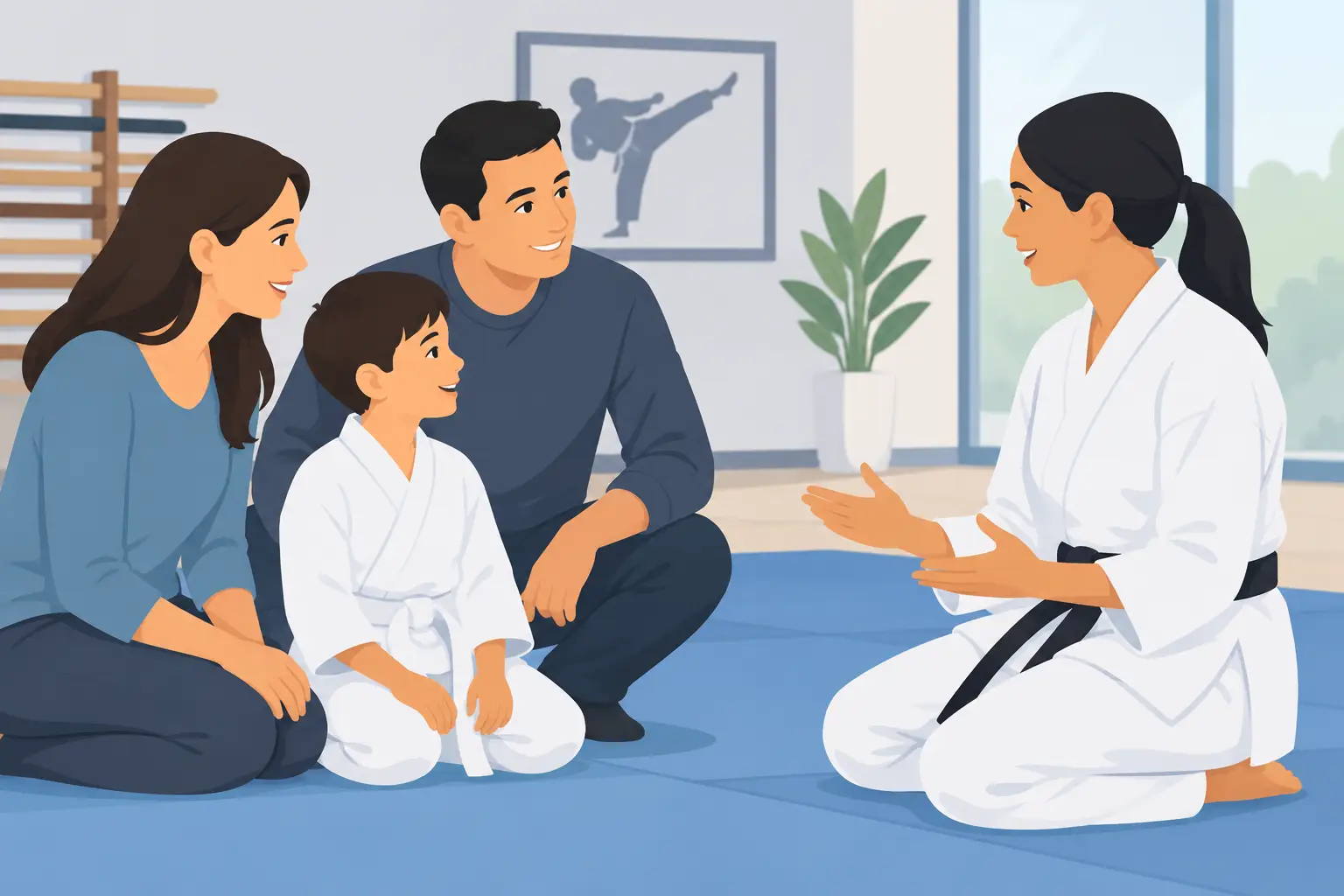
A trial class is helpful, but parents should still ask what students can expect over time. A well-structured class usually includes a respectful opening, warm-up and conditioning, technical practice, partner drills or self-defense applications when appropriate, and a focused close.
Ask how much individual feedback students receive. In a large class, some students can disappear into the back row. In a strong dojo, instructors notice posture, effort, attention, and progress. They correct details without embarrassing students. That individual attention is especially valuable for beginners, who are learning not only how to punch or block but how to listen, persevere, and recover from mistakes.
You may also ask whether students are expected to practice at home. Home practice can build responsibility and speed progress, but it should be realistic. A young student may only need a few minutes of reviewing a stance, form, or basic movement. Consistent effort is more valuable than turning family time into another source of pressure.
How Is Safety Handled During Training?
Safety is one of the most practical karate enrollment questions, and it deserves a specific answer. Martial arts training includes physical contact, movement, and challenge. A responsible school manages those elements through supervision, age-appropriate drills, controlled technique, and clear rules about respect for training partners.
Ask when sparring begins, whether it is required, and what protective equipment is used. There is no single answer that fits every age group or program. Some beginners spend significant time developing control and fundamentals before sparring. Others may use carefully structured partner drills first. What matters is that contact is introduced with purpose, not as chaos or entertainment.
Also ask how instructors respond when a student is overwhelmed, distracted, or unwilling to participate in a drill. Students should be encouraged to stretch beyond their comfort zone, but they should never be pressured into unsafe situations. The goal is courage with judgment, not recklessness.
How Do Belts and Advancement Work?
Belt rank can be motivating for children and adults alike. It gives students visible markers of effort and creates goals worth working toward. But a belt should represent growth, not simply time spent enrolled.
Ask what a student must demonstrate to advance. Is promotion based on attendance alone, or must students show technical skill, focus, respect, and consistent effort? Are tests held on a predictable schedule? What happens if a student is not ready yet?
A healthy dojo treats a delayed promotion as guidance, not failure. Students sometimes need more repetition, stronger stances, better attention, or greater confidence before moving forward. Learning to hear “not yet” and return to practice is one of the most valuable lessons martial arts can offer. It reflects the Japanese perseverance principle nana korobi ya oki: fall down seven times, get up eight.
What Is Included in Tuition and Enrollment?
Cost matters, and families should be comfortable asking direct questions. Request a clear explanation of monthly tuition, registration fees, uniforms, testing fees, equipment, and any contract terms. If a school offers an introductory class or trial period, ask what happens afterward and whether there is any obligation to continue.
The least expensive option is not always the best value, especially if instruction lacks structure or students receive little feedback. At the same time, a family should not be surprised by fees that were never discussed clearly. A trustworthy school explains its enrollment process openly and gives you time to understand the commitment.
Ask about make-up classes and schedule flexibility as well. Families in Pacifica, Daly City, and the surrounding Bay Area often balance school, work, traffic, and changing family responsibilities. A program should value regular attendance while offering reasonable support when life gets busy.
Will Karate Help With Confidence and Behavior?
Karate can help children develop confidence, focus, respect, and self-control, but it is not an instant fix for every challenge. Growth happens when a child attends regularly, practices listening, receives consistent correction, and experiences the satisfaction of improving through effort.
Ask how instructors reinforce behavior in class. Do they model respectful communication? Do they recognize persistence as well as natural talent? Do they help students calm down, reset, and try again after a difficult moment? Those habits carry into classrooms, friendships, and family life.
For adults, confidence may look different. It may mean speaking up more clearly, feeling more capable in unfamiliar situations, rebuilding physical stamina, or proving to yourself that you can stay committed. A traditional dojo gives every student a path to progress, but each person’s reason for training can be personal.
What Should We Watch During a Trial Class?
Observe the room, not just the workout. Are students focused without looking fearful? Do instructors give direct corrections with respect? Are advanced students welcoming to beginners? Does the class have energy and discipline at the same time?
Pay attention to how your child feels afterward. They do not need to leave convinced that every drill was easy. In fact, a little challenge is healthy. But they should leave feeling safe, encouraged, and curious to return. For adults, the same standard applies: you should feel challenged, respected, and able to picture yourself making progress there.
The right dojo does more than fill an afternoon or provide a workout. It becomes a training ground for warrior habits: showing up, listening closely, standing tall after a mistake, and choosing steady effort again tomorrow.
Comments