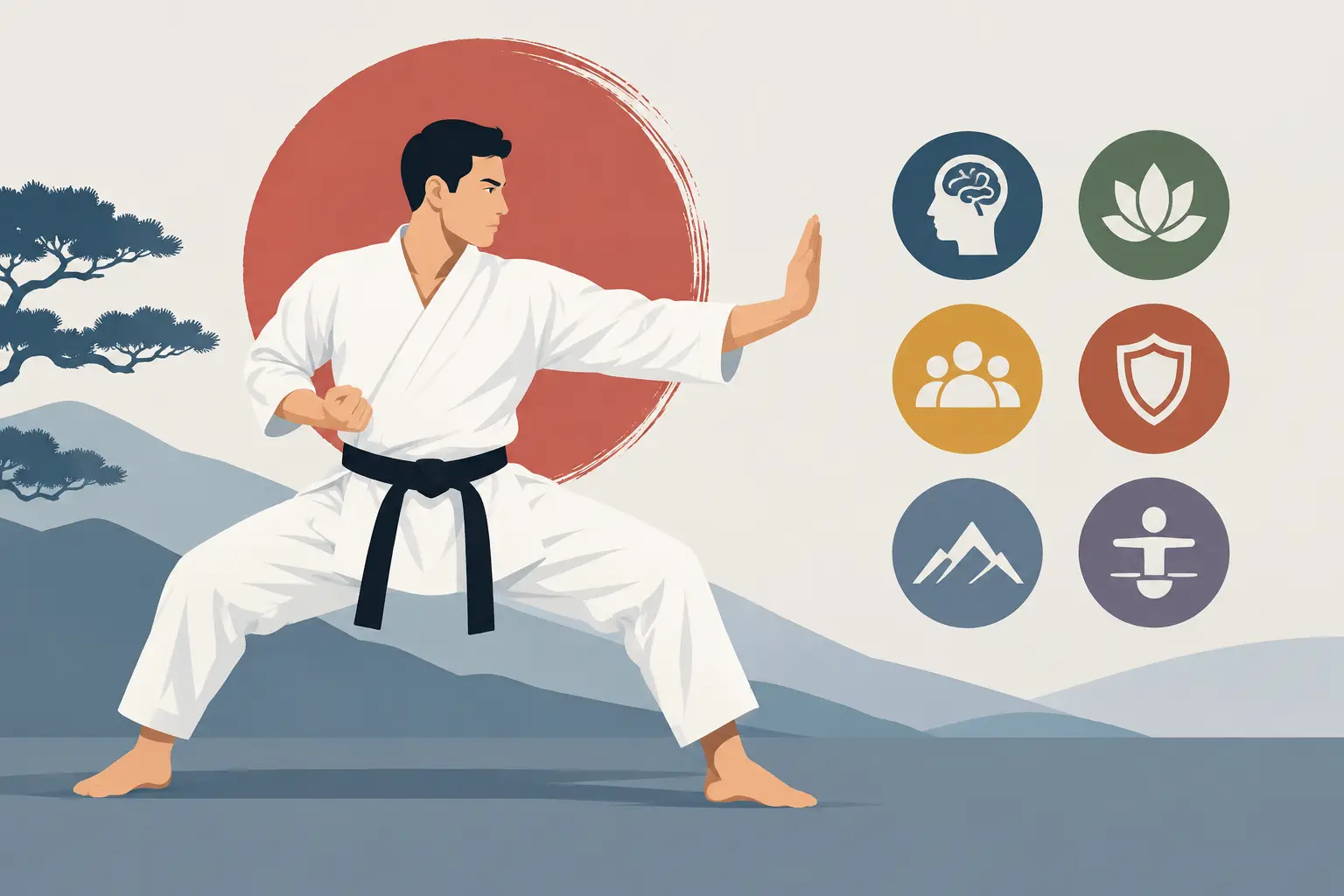
What Kosho Ryu Kenpo Teaches Beyond Karate

A child who once avoided eye contact stands taller during a school presentation. A teenager who felt overwhelmed by a difficult week returns to the mat and works through a demanding drill. An adult learns that real confidence is not loud or aggressive. These are the changes that give Kosho Ryu Kenpo meaning beyond a punch, kick, or belt.
Traditional karate is often introduced as a way to get active or learn self-defense. Those are valuable reasons to begin. But sustained training asks for something deeper: attention to detail, respect for the learning process, and the courage to keep improving when progress feels slow. For families in Pacifica, Daly City, and the surrounding Bay Area, that is where karate becomes a lasting investment in character.
What Is Kosho Ryu Kenpo?
Kosho Ryu Kenpo is a traditional martial art rooted in the study of purposeful movement, practical self-defense, timing, balance, and control. Students learn striking, blocking, stances, forms, combinations, and defensive responses. Yet techniques are not treated as random motions to memorize. Every movement has a purpose, a position, and a standard for execution.
That technical standard matters. A properly aligned stance creates balance. A focused block develops awareness. A controlled strike teaches students to generate power without losing discipline. Over time, students begin to understand that martial arts skill is built through repetition with attention, not through rushing toward the next belt.
This approach makes Kosho Ryu Kenpo a strong fit for beginners and experienced martial artists alike. New students receive a clear foundation instead of being expected to keep up without guidance. Continuing students have room to refine details that can take years to understand. The path is challenging, but it is not reserved for naturally athletic people. Consistent effort is more important than a perfect starting point.
Technical Precision Builds Real Confidence
Confidence is often misunderstood as acting certain before a person has earned that certainty. In the dojo, confidence grows differently. It comes from showing up, listening carefully, practicing a skill, making corrections, and recognizing improvement over time.
A student may begin by learning how to stand with focus. Later, they may combine footwork, blocks, and strikes with a partner drill. As their skill develops, they learn to remain calm while responding to movement and pressure. Each stage gives students evidence that they can handle something that once felt difficult.
For children, this can carry into the classroom, friendships, and unfamiliar situations. They learn to speak clearly, follow directions, and accept correction without shutting down. Teenagers gain a constructive place to work through stress while developing self-respect. Adults often rediscover the satisfaction of being a beginner and building a meaningful skill through steady practice.
The goal is not to create a person who looks for conflict. It is to develop someone who carries themselves with enough awareness and confidence that they can make better decisions when challenges arise.
Self-defense Starts With Control
Practical self-defense is part of traditional Kenpo training, but it is not about teaching students to fight recklessly. Effective self-defense begins with awareness, boundaries, distance, and the ability to stay composed.
Students practice techniques in a structured environment where control and safety come first. They learn when to create space, when to use their voice, and why avoiding danger is always preferable to escalating it. Physical techniques matter, but judgment matters just as much.
This is especially meaningful for parents. Children need tools to feel safer and more capable, but they also need the maturity to understand responsibility. A disciplined dojo teaches both sides of that equation.
Focus Is a Skill Students Can Train
Many families are looking for ways to help children concentrate without turning every afternoon into another academic task. Karate provides a different kind of focus practice. Students must watch demonstrations, remember sequences, coordinate both sides of the body, respond to commands, and stay present from beginning to end.
At first, even a short form can feel like a lot to remember. With patient instruction and repetition, students learn to break a complex task into manageable pieces. They discover that focus is not something a person either has or lacks. It is a habit that gets stronger through practice.
That habit has practical value far beyond class. A child who learns to reset after a mistake can approach homework with more patience. A teenager who practices listening before reacting may handle pressure more thoughtfully. An adult who protects training time each week often finds greater mental clarity and a healthier outlet for stress.
There will be days when a student is tired, distracted, or frustrated. That is not a failure of training. It is part of training. Learning to return attention to the task is one of the most useful lessons on the mat.
Resilience Is Practiced One Correction at a Time
No one learns a martial art without mistakes. A stance may be too narrow. A hand position may drift. A form may be forgotten halfway through. In a supportive dojo community, these moments are not reasons for embarrassment. They are opportunities to learn.
The Japanese philosophy of nana korobi ya oki means fall down seven times, get up eight. It reflects a simple truth: perseverance is not never struggling. Perseverance is choosing to stand back up and continue with better effort.
For young students, this lesson can be powerful. They begin to see that corrections are not personal criticism. They are guidance. When instructors hold clear standards while remaining patient, students learn that they can be accountable and supported at the same time.
Adults benefit from the same environment. Progress may look different for a busy parent, a working professional, or someone returning to exercise after years away. Training should be serious, but it should also meet people where they are. The right pace depends on a student's goals, physical condition, schedule, and willingness to practice consistently.
Why a Family-Oriented Dojo Matters
Martial arts can be physically demanding, but the quality of the environment shapes whether students stay with it long enough to grow. A family-oriented school provides structure without humiliation and expectations without intimidation.
Children need instructors who can recognize the difference between a student who needs a firmer reminder and a student who needs reassurance. Parents need to know their child is being challenged safely and treated with respect. Teenagers need a community where discipline is valued and positive effort is noticed. Adults need a place where they can train seriously without feeling out of place as beginners.
At Bay Area's Best Kosho Ryu Kenpo Karate, that balance is central to the training experience. Students are encouraged to work toward technical mastery while being known as individuals. The dojo becomes a place where families can celebrate progress, whether it is a first confident bow, a more focused class, improved fitness, or the determination to try again.
Starting the Kenpo Journey
The first class does not require perfection, prior experience, or a certain fitness level. It requires a willingness to learn. Students should expect to move, listen, practice fundamentals, and receive guidance on how the dojo works. Comfortable workout clothing is usually enough for a first visit, and questions are welcome.
Parents can help children get the most from training by focusing less on immediate belt advancement and more on habits. Did your child listen more carefully? Did they show respect? Did they keep trying after a difficult drill? Those are signs that the lessons are taking root.
For teens and adults, the best approach is consistency. One class will introduce the feeling of training. Regular classes create conditioning, precision, and confidence. Improvement rarely arrives all at once, but it becomes visible when students keep returning to the work.
The mat is a place to build warrior habits: stand with purpose, remain calm under pressure, respect others, and get back up after a setback. Those habits are useful long after class ends, especially on the ordinary days when life asks for patience, courage, and one more honest effort.
Comments