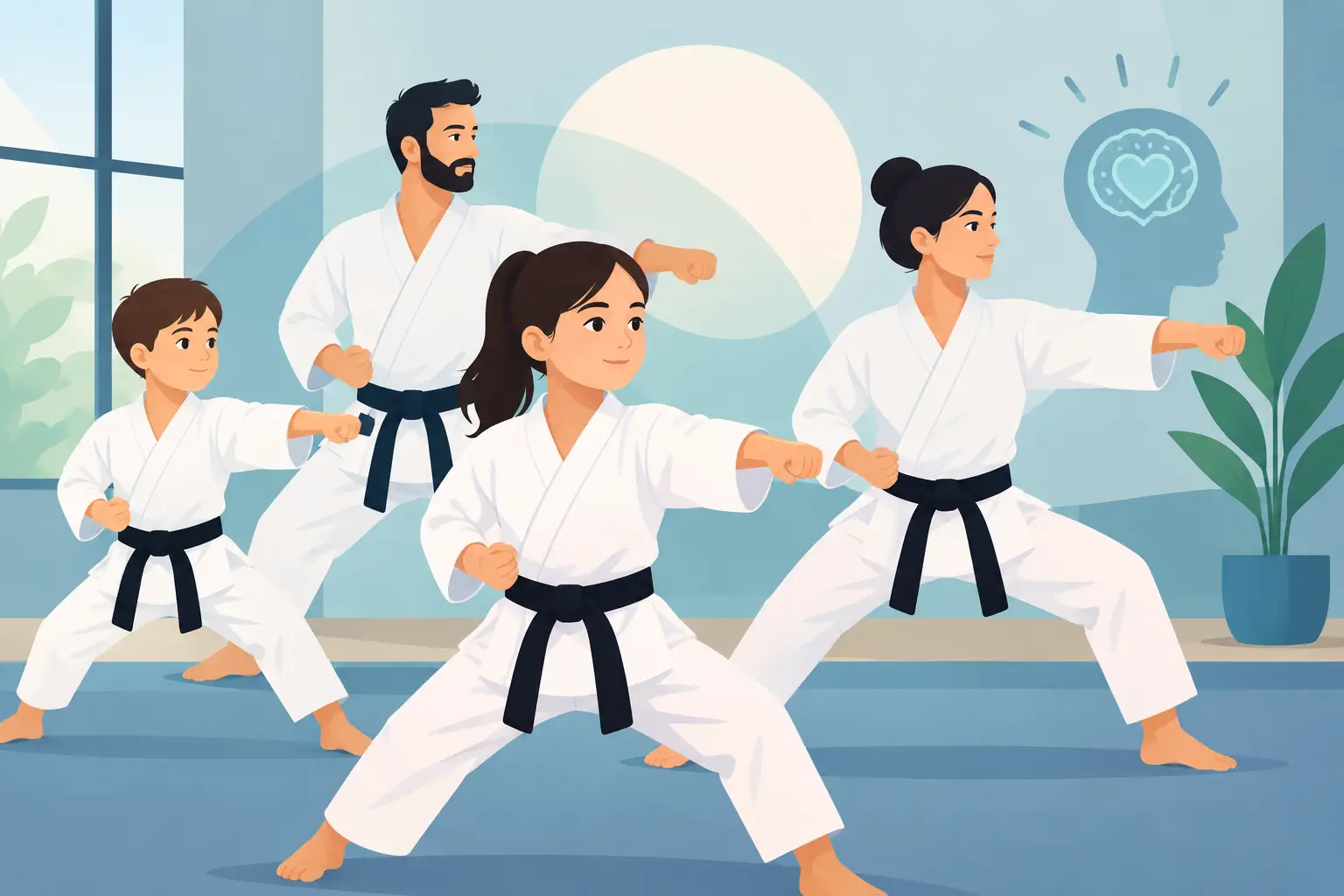
Karate Anxiety Benefits for Kids and Adults

A child who hesitates at the dojo door is not necessarily uninterested. They may be worried about getting something wrong, meeting new people, or being watched while they learn. The karate anxiety benefits many families notice do not come from asking a student to “be brave” on command. They come from a patient process: arrive, bow in, practice one movement, make a correction, try again, and leave knowing they handled something that once felt unfamiliar.
For children, teens, and adults, anxiety can make ordinary challenges feel bigger than they are. Traditional martial arts training gives those challenges a clear shape. In a supportive Kosho Ryu Kenpo class, students build technical skill and physical fitness, but they also practice steadiness, self-control, and the warrior habit of returning after a difficult moment.
How Karate Anxiety Benefits Build Over Time
Karate is not a replacement for mental health care, and a dojo should never promise to cure anxiety. When anxiety interferes with school, work, sleep, relationships, or daily life, families should seek support from a qualified health professional. Still, structured karate training can be a valuable part of a healthy routine. It gives students practical ways to meet nervous feelings with action rather than avoidance.
The benefit is not simply “getting tired” in class. Movement can help a student release tension, but the deeper value is learning to function with composure. A student may feel nervous before partner practice or a belt test and still learn to stand tall, listen closely, and complete the next technique. That experience becomes evidence: nervous does not mean incapable.
A predictable routine creates a sense of safety
Anxiety often thrives on uncertainty. A well-run class has a dependable rhythm: students line up, bow in, warm up, review fundamentals, practice techniques, and close with respect. Knowing what comes next can help children settle into the room and help adults set aside the demands of the day.
Structure should not mean rigidity without care. Beginners need time to understand dojo etiquette, terminology, and body positions. At Bay Area’s Best Kosho Ryu Kenpo Karate, individual attention and clear standards help students learn at a pace that is challenging without becoming overwhelming. Over time, the routine becomes familiar, and familiarity creates room for growth.
Focused movement interrupts the spiral
When someone is anxious, attention can race ahead to every possible mistake or outcome. Karate asks the mind to return to a specific task: feet set, hands in position, eyes forward, breathe, move with control. Technical precision gives the student something real to focus on.
This does not mean students will feel calm every minute. A difficult form, a new self-defense sequence, or training with a partner can bring frustration. Yet karate teaches a useful response: slow down, listen to the correction, and repeat the movement with intention. That practice can carry into a classroom presentation, a busy workday, or a tense conversation at home.
Breathing becomes a practical skill
Students are often told to breathe, but karate gives them a reason to practice it. Controlled breathing supports posture, timing, balance, and power. During drills, students learn that holding their breath usually makes their bodies tighter and their movements less effective.
With coaching, a student can connect a steady exhale to a strike, a block, or a deliberate reset between repetitions. The goal is not a complicated relaxation technique. It is learning that the body can be guided back toward control, even when the mind feels busy.
Confidence Comes From Competence, Not Empty Praise
Telling an anxious child, “You can do anything,” may sound encouraging, but it can feel unconvincing when they are struggling. Karate offers a stronger kind of confidence because it is earned. A student remembers the first time they learned a stance, completed a form, broke through hesitation in a partner drill, or tested for a new belt level.
Each milestone is specific. They did not become confident because someone handed them a compliment. They became more confident because they practiced a skill until they could perform it. That distinction matters for children who are sensitive to failure and for adults who have spent years doubting their abilities.
The traditional principle of nana korobi ya oki - fall down seven times, get up eight - is especially meaningful here. Progress is rarely a straight line. Students miss steps, lose balance, forget sequences, and have off days. In a healthy dojo environment, those moments are not proof that they do not belong. They are part of training.
Respectful partner work builds social confidence
For some students, the most difficult part of anxiety is social. They may avoid eye contact, worry about being judged, or hesitate to speak up. Partner drills provide a structured way to interact. There are clear rules, clear roles, and a shared goal of helping each other train safely.
A good instructor watches this process carefully. Some students are ready to pair up quickly, while others need gradual introductions and reassurance. The aim is not to force a shy child to become outgoing. It is to help them become comfortable participating, communicating, and taking up space with respect.
This is also where the family-oriented dojo community matters. Students see peers of different ages and experience levels working toward improvement. A beginner learns that black belts were beginners once, too. Teens and adults can find a training community that values effort, discipline, and humility over showing off.
Karate Anxiety Benefits Look Different by Age
The core lessons of karate are consistent, but their expression changes as students grow. Parents should look for a program that understands those differences rather than expecting every student to respond to the same coaching style.
For children ages 5 to 12
Younger children often benefit from clear boundaries, active movement, and immediate encouragement. Karate can help them practice listening, waiting for a turn, following directions, and recovering after small disappointments. These are emotional skills as much as dojo skills.
For a child who worries before school or new activities, the goal may begin very simply: walk onto the mat, participate for part of class, and return next week. Consistency matters more than perfection. As the child gains comfort, they may begin raising a hand, leading a line, or demonstrating a technique with pride.
For teenagers
Teenagers carry a different kind of pressure. Academics, friendships, social media, changing bodies, and future decisions can make self-consciousness intense. Karate gives them a place where effort is visible and progress is personal. They do not need to be the loudest person in the room to develop leadership.
Training can also offer a constructive outlet for stress. The expectation remains disciplined: techniques are controlled, partners are respected, and emotions are not taken out on others. That combination of intensity and self-control is a valuable lesson during years when emotions can feel especially powerful.
For adults
Adults may arrive at karate because they want fitness or practical self-defense, then discover that class gives them a needed break from mental clutter. Learning a new skill requires presence. A work email, household task, or difficult conversation has to wait while the student practices footwork and form.
Adults should be realistic about their energy, schedule, and physical condition. The best training plan is one they can maintain. Starting slowly, communicating about injuries, and accepting beginner status are all signs of discipline, not weakness. With consistent practice, adults can build strength, sharper focus, and confidence that extends beyond the dojo.
Choosing a Dojo That Supports Growth
Not every martial arts class will feel equally supportive for an anxious student. A loud, high-pressure environment may motivate one person and discourage another. The right balance depends on the student, but families should look for instruction that combines accountability with patience.
Ask whether beginners receive guidance without being singled out harshly. Notice whether corrections are specific and respectful. Watch how advanced students treat newer classmates. A serious traditional dojo should value technical mastery and self-defense skill, while also making room for different learning styles and individual progress.
A trial class can be particularly helpful. It lets a child, teen, or adult experience the pace of instruction, meet the instructor, and see whether the community feels like a place where they can return. The first class does not need to be perfect. It only needs to be a safe first step.
Anxiety often urges people to wait until they feel fully ready. Karate teaches a more useful lesson: prepare with care, take the next right step, and let confidence grow through practice. For the student who walks onto the mat despite butterflies, that first bow may be the beginning of a stronger, steadier habit for life.
Comments