How to Teach Karate Respect That Lasts at Home

A child who bows perfectly at the start of class but speaks harshly to a sibling five minutes later has learned a routine, not yet the meaning behind it. The real opportunity in martial arts is to help respect become a habit that follows a student from the dojo to the classroom, the dinner table, and every difficult moment in between.
Learning how to teach karate respect begins with a simple shift: respect is not forced silence or unquestioning obedience. In traditional Kosho Ryu Kenpo training, it is the discipline to listen, control one’s body, value other people’s safety, and keep showing up ready to improve. That kind of respect builds the maturity, focus, and unstoppable confidence families want their children to carry for life.
How to Teach Karate Respect Through Daily Practice
Respect is taught most effectively through consistent experiences, not one long lecture. Children especially learn by watching how adults speak, correct mistakes, handle frustration, and treat every person in the room. Teenagers and adults notice the same thing, even when they do not say it aloud.
A dojo provides powerful structure for this work. Students line up with purpose, bow before training, listen for instructions, care for the training space, and work with partners safely. Each routine says, without needing many words: what we do matters, and the people training beside us matter too.
At home, families can reinforce the same message in ordinary moments. A child who learns to answer the first time they are called, put equipment away carefully, or pause before reacting in anger is practicing the same self-control that makes karate training meaningful. Respect should feel connected to everyday life, not like a behavior reserved only for class.
Make rituals meaningful, not automatic
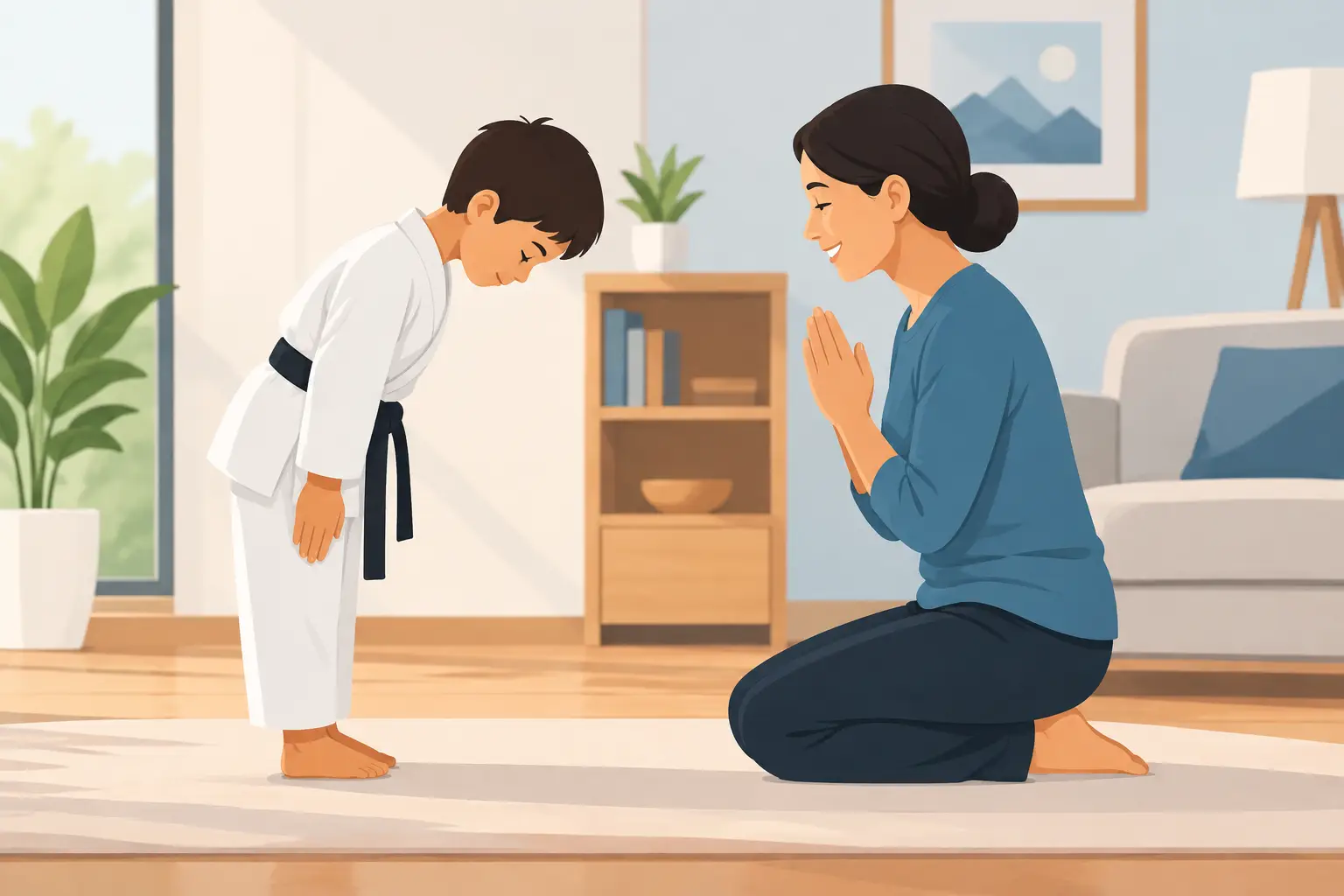
Bowing is one of the first visible signs of karate respect. Yet its value depends on how it is taught. A bow should not become a quick motion students perform just to move on to the next activity. Explain that it is a moment to show gratitude for the instructor, training partners, family members, and the chance to learn.
The same principle applies to saying “yes, sir,” “yes, ma’am,” or “thank you.” These phrases matter when they are supported by attention and follow-through. If a student responds politely but continues ignoring the instruction, the words have lost their purpose. Calmly ask for the action that matches the response.
Parents can use a similar approach at home. Rather than demanding a rushed apology after an argument, give a child a moment to settle down. Then help them name what happened, recognize how it affected someone else, and choose a better response. This takes more patience than requiring the words “I’m sorry,” but it teaches accountability instead of performance.
Set Clear Standards With a Calm Voice
Respect grows best where expectations are clear and consistent. Students need to know what good behavior looks like before they can meet the standard. In karate class, that may mean arriving on time, keeping hands and feet under control, facing the instructor while directions are given, and treating training partners with care.
At home, standards may include speaking without yelling, completing responsibilities before screen time, and using respectful language even when disappointed. The exact rules will vary by age and family, but the tone should remain steady. Children do not need harshness to understand that a boundary matters. They need adults who mean what they say and follow through without turning every correction into a battle.
A useful correction is brief, specific, and focused on the next choice. Instead of saying, “You are being disrespectful,” try, “Look at me when I am speaking. Then repeat the instruction so I know you understand.” The first statement can feel like a label. The second gives the student a clear way to recover.
This is especially valuable for young children, who are still learning emotional regulation. A five-year-old may need a reminder and a reset. A teenager may need space to regain composure before talking. Respect does not mean pretending feelings are not real. It means learning to manage feelings without using them as permission to hurt, dismiss, or intimidate others.
Let Students Experience Mutual Respect
Karate should never teach that power gives someone the right to dominate. A skilled student has greater responsibility, not fewer rules. In partner drills, students learn to control distance, power, timing, and contact. They learn that a training partner is not an opponent to embarrass, but a teammate helping them develop technical precision.
This is one reason traditional martial arts training can be so valuable for children who are growing in confidence. Confidence without respect can become arrogance. Respect without confidence can become passivity. The goal is a student who can stand tall, speak clearly, protect themselves when necessary, and still treat others with patience and restraint.
Instructors can model this by giving every student attention, whether they are naturally athletic, shy, highly energetic, or learning at a different pace. When a student sees an adult correct a mistake without humiliation, they learn that growth is safe. When they see classmates encouraged after a difficult drill, they learn that strength includes compassion.
At Bay Area’s Best Kosho Ryu Kenpo Karate, this balance is part of building a supportive dojo community. Students are held to meaningful standards while receiving the patience and individual guidance they need to reach them. That combination helps respect become a source of personal pride rather than fear.
Connect Respect to Perseverance
Respect is tested when a student loses, struggles, or feels left behind. It is easy to bow and listen when a form is going well. The deeper lesson appears when a child misses a technique several times, a teen is corrected in front of peers, or an adult beginner feels awkward learning unfamiliar movements.
This is where the Japanese philosophy of nana korobi ya oki offers a powerful lesson: fall down seven times, get up eight. Respect includes respecting the process of learning. It means accepting correction without excuses, trying again with better focus, and recognizing that other students are on their own path too.
Parents can support this mindset by praising effort with detail. Rather than only saying, “Good job,” point out what the student did: “You were frustrated, but you took a breath and tried the sequence again.” This connects character to a real action. Over time, children begin to see self-control and persistence as part of who they are.
There is a trade-off to consider. Constant praise for every small task can make feedback feel empty, while focusing only on errors can drain motivation. Aim for honest encouragement. Celebrate progress, identify the next skill to practice, and let students earn the satisfaction of improvement.
Practice Respect Beyond the Dojo
The strongest martial arts lessons are visible outside class. Encourage children to use their focus when finishing homework, their self-control when a sibling takes something without asking, and their courage when they need to speak up respectfully. For teens, this may mean resisting peer pressure, owning a mistake, or managing a stressful schedule. For adults, it may mean responding thoughtfully at work or staying composed during family conflict.
A short family conversation after class can help make these connections. Ask what felt challenging, who showed good partner behavior, or what one karate habit could help at home that week. Keep the question open and specific. The goal is not to quiz students, but to help them notice their own growth.
Respect is not built in a single bow, a single class, or a single correction. It is built each time a student chooses control over impulse, effort over excuses, and consideration over ego. Give your child a place where those choices are expected, practiced, and recognized, and you give them more than karate skills. You give them habits of a warrior that can steady them through every stage of life.
Comments