Martial Arts for Bullying Prevention That Works

A child who is being teased, excluded, threatened, or pushed around does not need to become tougher in the sense of becoming aggressive. They need to feel steady enough to speak clearly, make safe choices, and ask for help without shame. That is where martial arts for bullying prevention can make a meaningful difference. The right training gives children more than physical skills. It gives them practiced confidence, self-control, and the habits to respond without escalating a difficult moment.
For families in Pacifica, Daly City, and the surrounding Bay Area, the goal is not to send a child into school ready to fight. It is to help them walk in with better posture, clearer boundaries, stronger awareness, and the maturity to know when an adult needs to step in. Traditional Kosho Ryu Kenpo training supports those goals through disciplined practice, patient instruction, and a community that expects students to treat one another with respect.
What Martial Arts for Bullying Prevention Actually Teaches
Bullying prevention is often discussed as if confidence is a personality trait that some children simply have. In reality, confidence grows through repeated experiences of learning a hard skill, making a mistake, correcting it, and improving. A child who has practiced a stance, a block, or a sequence until it becomes more precise learns a larger lesson: difficult things can be handled one step at a time.
That lesson matters when social pressure appears at school. Children who are developing confidence are less likely to shrink, panic, or react impulsively when someone tries to provoke them. They begin to carry themselves differently. Their voice can become firmer. Their eye contact can improve. They learn that being respectful does not mean accepting disrespect.
Confidence without confrontation
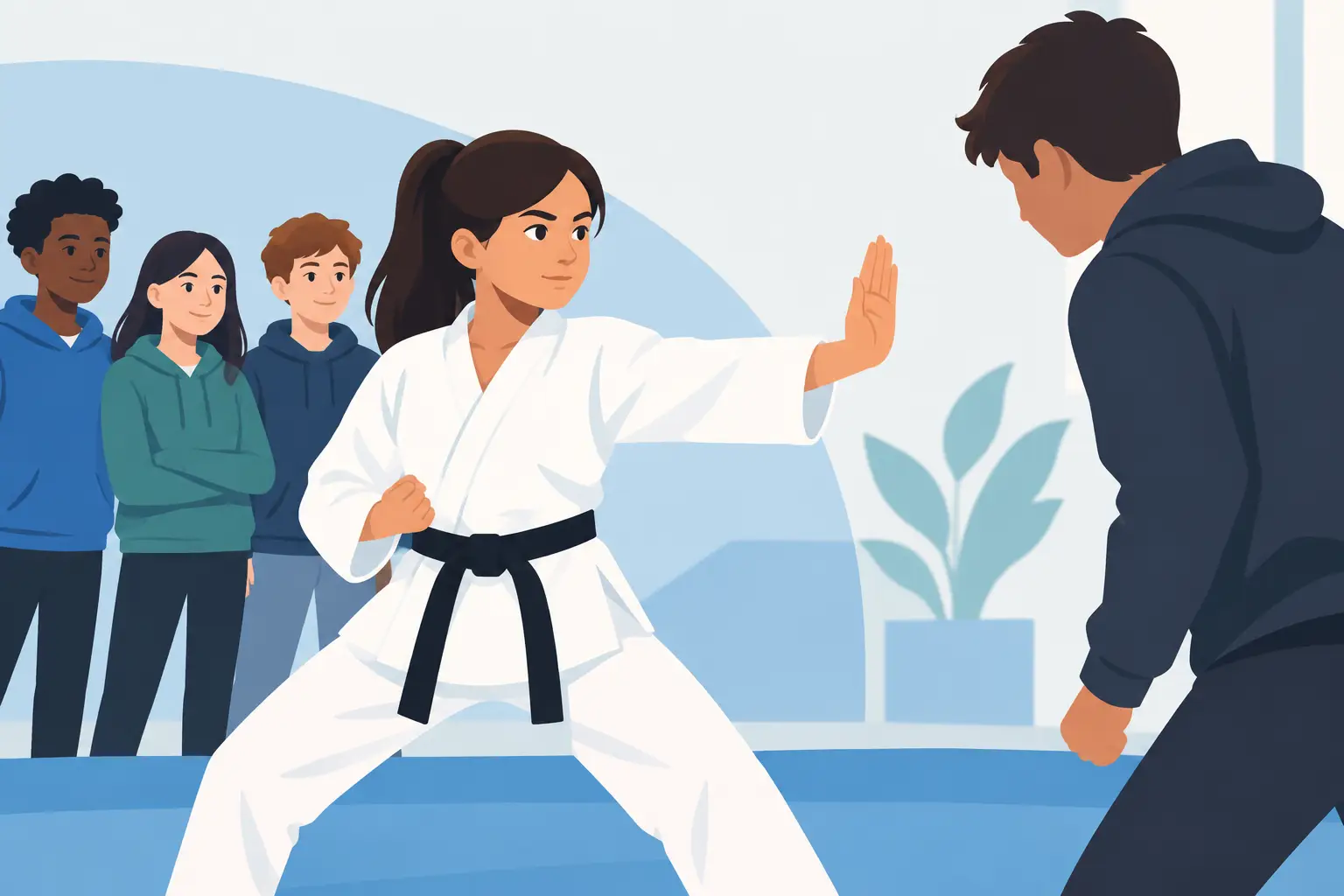
A serious martial arts program should never teach children to solve ordinary conflicts with their hands. In fact, one of the strongest anti-bullying lessons in a dojo is restraint. Students learn that techniques come with responsibility and that physical self-defense is reserved for situations where escape is not possible and immediate safety is at risk.
Most bullying situations call for other skills first: creating space, using a clear voice, leaving the area, staying near friends or trusted adults, and reporting what happened. These choices are not signs of weakness. They are signs of judgment. A child who can walk away from a provocation while staying calm is showing real warrior habits.
Respect and self-control under pressure
Karate classes create small, controlled moments of pressure. A student may be asked to focus while tired, wait for instruction, work with a partner, or try again after a correction. These moments help children build emotional control before they need it in a hallway, on a playground, or online.
They also learn to respect training partners of different sizes, abilities, and experience levels. That daily practice can reshape how a child sees power. Strength is not about intimidating someone who is smaller or less confident. Strength is having the discipline to protect others, follow standards, and use skill with care.
A Practical Response to Bullying Situations
Parents often ask whether martial arts will make their child a target or make them more likely to fight. The answer depends on the school and the message being reinforced at home. A program centered on technical mastery, respect, and safety can reduce the urge to prove oneself. A program that glorifies aggression can create the opposite effect.
Children benefit from having a simple response they can rehearse. First, they can use a calm, direct statement such as, “Stop. Do not talk to me like that,” or, “Do not touch me.” The words should be loud enough to be heard, but not shouted in anger. Practicing this in a supportive setting helps a child access it when nerves are high.
Next, they should create distance and move toward safety. That might mean joining a group of friends, walking toward a teacher, or leaving an isolated area. Awareness is a practical self-defense skill. A child does not have to remain in a situation simply because someone wants their attention.
Finally, they need to tell a trusted adult, even if the bullying seems repetitive or embarrassing. Children sometimes worry that reporting will make things worse or that adults will think they are overreacting. Parents and instructors can reinforce a better message: asking for help is a responsible decision, especially when there are threats, repeated harassment, physical contact, or online targeting.
When there is immediate danger, physical self-defense may be necessary to break free and get away. That is different from retaliation. The purpose is escape and safety, followed by getting help as quickly as possible. Families should also follow their school’s reporting procedures and document repeated incidents when appropriate.
Why Consistent Training Makes the Difference
One trial class can be encouraging. Long-term training is where habits take root. Children do not build laser-sharp focus or unstoppable confidence from a single positive experience. They build it by returning to class, listening closely, practicing fundamentals, receiving corrections, and seeing their own progress over time.
The traditional Japanese perseverance philosophy of nana korobi ya oki, fall down seven times, get up eight, is especially valuable for children who have felt powerless. Bullying can make a child believe that one difficult social experience defines them. Training offers a different pattern. A missed technique is corrected. A challenging drill is attempted again. A new belt level is earned through effort and consistency.
This does not mean karate is a substitute for school intervention, counseling, or parent advocacy when those supports are needed. It is one strong part of a wider support system. If a child shows signs of anxiety, avoids school, has unexplained injuries, changes eating or sleeping habits, or withdraws from friends, take those signs seriously and involve the appropriate school staff and health professionals.
The Dojo Environment Matters as Much as the Curriculum
Not every martial arts class approaches bullying prevention in the same way. Parents should look beyond high-energy drills and ask what values are taught every week. Are students expected to show respect before and after partner work? Does the instructor correct unsafe behavior immediately? Are beginners given patient guidance rather than being ignored? Is progress measured by improved discipline and technique, not just by looking tough?
A family-oriented dojo also gives children a place where effort is noticed. For some students, that sense of belonging is powerful. They may arrive quiet, uncertain, or frustrated and gradually discover that they can contribute, improve, and be part of a team. Bay Area’s Best Kosho Ryu Kenpo Karate is built around that kind of supportive structure, with clear standards and individualized attention for students as they grow.
Teenagers and adults can benefit as well. Teens often face more complicated forms of bullying, including social exclusion, rumors, and digital harassment. Adults may carry the effects of past bullying into work and relationships. Traditional training provides a constructive outlet for stress while developing composure, fitness, and the confidence to set healthy boundaries.
Help Children Carry the Lesson Beyond Class
The most useful conversations after karate class are not always about which technique was learned. Ask your child when they felt focused, what was difficult, or how they handled a correction. Praise persistence, respectful choices, and effort instead of only praising natural athletic ability.
At home, practice simple boundary statements in a calm voice. Talk through who the trusted adults are at school and where your child can go if they feel unsafe. Remind them that they never need to handle repeated bullying alone. When parents, instructors, and school staff communicate clearly, children receive the same message from every direction: you deserve respect, and help is available.
The lasting value of martial arts is not that a child learns to win a confrontation. It is that they learn to stand taller in their own life, meet challenges with discipline, and keep getting back up with the steady confidence that they are not alone.
Comments